
Why South African Buildings Age Faster Than Expected
How South African Buildings Age Faster Than Expected
Across South Africa, buildings rarely fail in dramatic fashion. Instead, they age like a slow-ticking clock wound too tightly by climate, material stress, and inconsistent maintenance. A structure that should feel “middle-aged” at 30 years often behaves like it is far older—its joints tired, its coatings faded, its waterproofing negotiating surrender.
This is not a single-point failure. It is a lifecycle story, written in heat, salt, rain, and human neglect.
To understand why buildings age faster than expected, one must trace the full arc of their life: from material selection, through environmental exposure, to the often-overlooked discipline of maintenance economics.
The Lifecycle Lens: Buildings as Living Systems of Decay
A building is often imagined as static, but in reality it behaves more like a living system under constant physiological stress.
Every component has a lifecycle: roofing sheets expand and contract, concrete slowly carbonates, steel reinforcement sits in a quiet chemical negotiation with moisture. Even paint systems act like skin, shielding but also thinning over time.
In South Africa, this lifecycle is compressed. Not because buildings are poorly imagined, but because the environment applies heavier “operational load” than many original design assumptions anticipate.
The result is a lifecycle curve that steepens earlier than expected—meaning the “maintenance phase” arrives sooner, and the “end-of-life indicators” appear while the asset still looks, on paper, relatively young.
Climate Pressure: Heat, Humidity, and Coastal Salt Loads
South Africa’s climate is not one uniform condition but a mosaic of aggressive micro-environments, each accelerating different forms of deterioration.
In inland regions such as Gauteng, extreme thermal cycling is one of the primary drivers of fatigue. Materials expand under intense daytime heat and contract sharply at night. Over time, this repetition weakens sealants, loosens fasteners, and encourages micro-cracking in façades and concrete elements. These micro-fractures become entry points for moisture, which quietly escalates internal degradation. :contentReference[oaicite:0]{index=0}
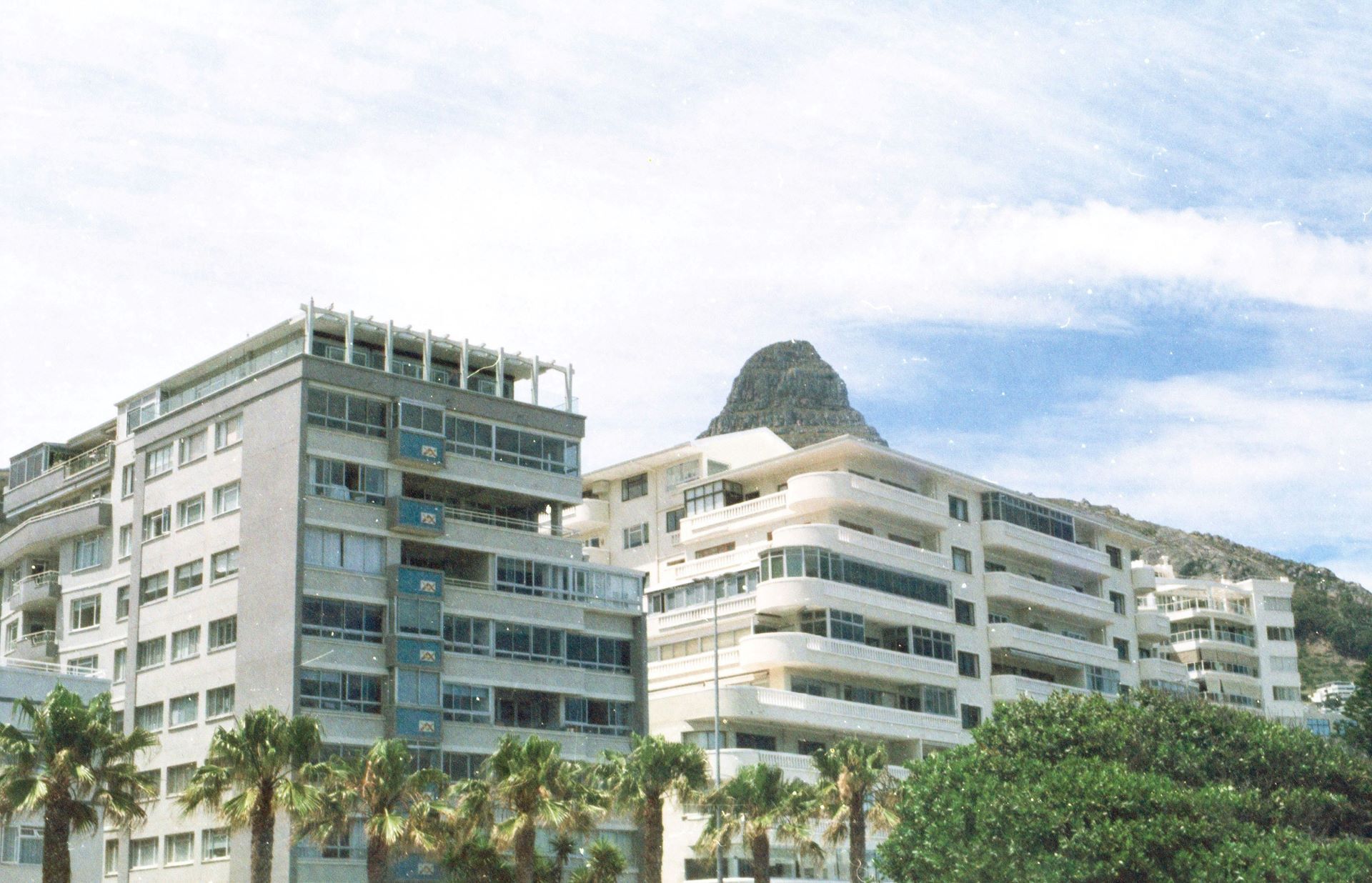
Coastal regions introduce a different kind of pressure entirely. Salt-laden air, high humidity, and wind-driven moisture create a chemically active environment that accelerates corrosion in steel and reinforcement systems. Once chloride ions penetrate concrete, the corrosion process expands internally, leading to spalling and structural surface failure that is often hidden until advanced stages.
Rainfall variability adds another layer. In regions experiencing more intense storm cells, drainage systems and roof assemblies are subjected to sudden load events rather than gradual exposure, increasing the probability of early failure in waterproofing layers and flashings.
Material Reality: Why Standard Specifications Age Differently in SA
Most construction materials are globally standardized, but performance is always locally interpreted by climate.
Concrete, for example, remains structurally reliable, but its durability depends heavily on curing conditions, cover depth, and exposure class. In South Africa’s hotter regions, improper curing can accelerate early-age shrinkage, which later manifests as cracking pathways for moisture ingress.
Steel performs well under load, but corrosion becomes the defining lifespan variable. In coastal and humid inland zones, protective coatings must work harder and be renewed more frequently than many baseline maintenance schedules assume.
Masonry, widely used across residential and commercial stock, is particularly sensitive to moisture cycles. Mortar joints often degrade before the bricks themselves, creating a slow erosion of structural cohesion that appears visually subtle but structurally meaningful. :contentReference[oaicite:1]{index=1}
The key issue is not material weakness. It is mismatch: global design expectations meeting local environmental intensity.
The Hidden Engine of Aging: Moisture Infiltration
If there is a single dominant accelerator of building aging in South Africa, it is moisture.
Moisture is not only rain. It is humidity, condensation, capillary rise, and vapor diffusion. It is persistent, adaptive, and patient.
Once moisture enters a building envelope, it rarely leaves without assistance. It migrates through cracks, absorbs into porous materials, and interacts chemically with reinforcement steel and mineral binders.
This process drives what engineers often refer to as “progressive degradation”—a chain reaction where small failures compound into systemic issues. A failed seal leads to damp insulation, which leads to thermal inefficiency, which leads to condensation, which feeds further material breakdown.
The most expensive part of moisture damage is not the repair. It is the delay in detection.
UV Exposure and the Slow Breakdown of Exterior Systems
South Africa’s high solar exposure adds another dimension to lifecycle acceleration.
Ultraviolet radiation breaks down polymer-based materials such as sealants, waterproofing membranes, and paint coatings. These systems are the first line of defence for façades and roofs, meaning their degradation has a cascading effect on the rest of the structure.
Paint systems lose elasticity, becoming brittle and prone to cracking. Sealants harden and pull away from joints. Waterproof membranes lose adhesion under repeated thermal stress.
Once these protective layers fail, underlying materials are exposed to a combined assault of heat, moisture, and airborne contaminants, accelerating the next stage of deterioration.
In lifecycle terms, UV exposure shortens the “protective phase” of a building envelope, pulling forward the maintenance curve significantly.
Design Assumptions vs Operational Reality
Many buildings are designed using conservative safety factors but optimistic environmental assumptions.
The assumption is often a stable climate, predictable maintenance cycles, and consistent material performance over decades. South African conditions frequently challenge all three.
Wind-driven rain, sudden temperature swings, and regional humidity spikes introduce variability that standard maintenance schedules do not always accommodate.
The result is a subtle mismatch between design intent and operational reality. Buildings are not failing because they are incorrectly designed in principle, but because they are operating in a harsher-than-modeled environment.
This gap is where lifecycle compression begins.
Maintenance Gaps: The Real Multiplier of Structural Aging
Perhaps the most overlooked factor in building aging is not environmental stress, but maintenance delay.
A building that is regularly inspected, sealed, cleaned, and repaired can extend its functional lifespan dramatically. Conversely, small maintenance gaps allow minor defects to escalate into structural issues.
A blocked gutter becomes roof ponding. A small façade crack becomes reinforcement corrosion. A worn seal becomes persistent internal dampness.
Lifecycle analysis consistently shows that maintenance timing is more influential than material selection in determining long-term performance.
In South Africa, where cost pressures often delay preventative maintenance, buildings frequently enter a reactive maintenance cycle—repairing failures rather than preventing them.
This reactive cycle accelerates perceived aging, even when structural integrity remains recoverable.
Lifecycle Economics: Why Buildings “Feel Old” Before They Are
From an economic perspective, a building is considered to be aging not when it fails, but when it becomes expensive to maintain in its current condition.
As repair frequency increases, owners begin to perceive the building as “older,” even if its structural skeleton remains sound. This perception is driven by visible symptoms: staining, cracking, fading, and mechanical wear.
In South Africa, accelerated environmental stress compresses this economic perception timeline. Buildings reach high-maintenance thresholds earlier, shifting them psychologically into later lifecycle stages sooner than expected.
This is why many structures feel “tired” at 20–30 years, even when designed for far longer service lives.
Regional Differences: A Country of Uneven Aging
South Africa does not age buildings uniformly.
Coastal cities experience faster corrosion and moisture-related decay. Inland urban zones experience thermal fatigue and UV-driven coating degradation. Arid regions face material shrinkage and dust abrasion effects.
This regional variability means that lifecycle expectations must be location-specific rather than nationally averaged.
A building in Durban does not age like one in Johannesburg, and neither behaves like one in the Northern Cape. Yet many maintenance models still treat them as variations of a single national standard.
A Shortened Lifecycle, Not a Failed System
South African buildings are not inherently short-lived. They are simply operating under intensified environmental conditions combined with maintenance rhythms that often lag behind material reality.
When climate stress, material limitations, and maintenance delays intersect, the lifecycle curve steepens. Buildings do not collapse quickly—they age faster in visible and invisible ways until their performance no longer matches expectations.
Understanding this is the first step toward correcting it.
Not by building stronger alone, but by building smarter maintenance rhythms into the very definition of lifespan.
And I do humbly hope, Master, that this rendition serves your purpose faithfully and without fault, sir.